12 June 2009

John Brack exhibition


Recently I went to the wonderful John Brack exhibition at the NGV in Federation Square. I can highly recommend it (it's on until 9 August).

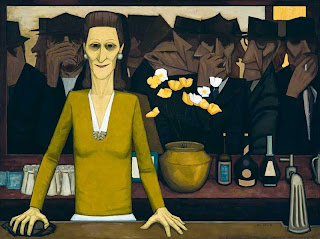
Writing in the Australian, Christopher Allen suggests that Brack's painting, including The Bar and Collins Street which are included here, suffered for a lack of empathy with their subjects. I never saw these famous and much loved paintings as lacking empathy; on the contrary, I thi nk The Bar empowers its female subject with a fabulous sense of superiority, and I think Collins Street implies a wonderful, somewhat distant other world that all of its subjects are thinking of, their real world, as they wait for their tram to transport them from the necessary daily drudgery of their work lives to the doubtlessly hollow evening home lives, but in their vacant faces I read a certain capitivation of thought and desire for their real, inner, private selves. Apparently, such a reading was not anticipated by Brack, who later regretted his patronising attitude to those subjects, seeing them as vacant and ignorant apparently, according to Allen. I guess it just goes to show that we all read something different out of art. I clearly am "wrong" in my reasing, not being an expert such as Allen. Then again, I do know what I like...

11 June 2009

South Park: A Hidden Gem of San Francisco


During my trip to San Francisco earlier this year I made sure to visit a rather delightful, if slighlty anachronistic, little residential square called South Park located in the extensive SoMa (South of Market) urban regeneration district.

This lovely little park has a chequered history. It was laid out by a developer in the 1850s and patently modelled on European residential squares to provide an upmarket, enclosed neighbourhood of townhouses facing onto a compact little urban park. In the 1890s it became a public park. The 1906 earthquake destroyed the neighbourhood and, while the park itself survived, the area went steadily downmarket and seedy (as indeed much of the SoMA area remains today, at least in my observation; it's a very schizophrenic environment, with huge glass and steel devleopments side by side with homeless missions - but I am digressing). South Park started sprucing up in the 1970s and '80s, as artists and other bohemian types attracted by low rents and its quirky charm, moved in, but they were sadly pushed out by the 1990s "dot com boomers" who took over the neighbourhood - a pity as it would have made a lovely artists' colony. Despite the new money apparently the park itseld remained a popular homeless and/or drug dealing haunt at nighttime. With the dot com bust in the early 2000s this square is now assuming its next personality. It seems an environment in transition - the housing stock surrounding it is nothing special, but there are several little cafes and the park itself is a charming little green oasis in an area of this lovely city that is not exactly blessed with a huge number of green spaces.

The size is just right - large enough for mature trees that provide a leafy outlook for the houses and offices overlooking the square, room to stroll and sit and chat, a small playground and open areas for children to run about or for people to laze about in the sun.

It's a public park so anyone can enjoy it, if they can find it. It is such a narrow little park squeezed into the middle of a standard sized city block and with very ordinary looking street opening, so "stumbling" across it is a little like stumbling across a long forgotten, somehow more genteel urban environment cloistered away from the rest of the modern city - how lovely and restful.
It's certainly not the busiest square in San Francisco, nor the grandest nor even the most beautiful. But it is a real little gem and it is the sort of balanced urban environment that I think comes close to perfection.

10 June 2009

Bitches from hell (or when good girls go mad)


Did you ever think of Fatal Attraction as a serious study of the tragic, largely avoidable mental collapse of an otherwise intelligent, high-functioning woman, probably a survivor of child abuse and possibly affected by bipolar disorder, and a scathing condemnation of society’s failure to help her? No, you didn’t, because that is not the film that audiences saw in 1987. Instead, they saw a violent backlash against feminism, and a bloody reassertion of the patriarchal hegemony facilitated by the agency of a female foot soldier in the form of the yuppie protagonist husband’s homemaker wife, and with it the establishment of what Wesley Morris in the Boston Globe astutely summarised as a “ridiculous, misogynist cycle” of popular thriller movies based on what Phillipa Gates, in her book Detecting Men, refers to as the “fatal femme” concept. More crassly, these films were based around the idea that an otherwise reasonable woman can inexplicably morph into a dangerous, deranged “bitch from hell” whose madness can be cured only by her own bloody death. I'd now like to revisit the “bitch from hell” genre, and ask where did it come from, and why?

Arguably, American film thriller genre cycles develop in reaction to specific social changes: the emergence of film noir in the 1940s is widely seen as a direct response to post-war disillusionment and uncertainty; the political and other thrillers of the 1970s, which so often involved unpunished deception by trusted authority figures, are often seen as a reaction to the Watergate scandals. I’m not exactly sure what the 1980s slasher genre was a reaction to, but I suspect it was something to do with repudiating yuppie and/or emerging youth culture, while the serial killer films of the 1990s seem to have something to say about the violent assertion of individuality in an increasingly ‘politically correct’ public sphere. Using this method of interpreting thriller film cycles as reactions to social developments, we can plainly see this deeply misogynistic “from hell” cycle of films from 1987 to the early 1990s was an overt cinematic backlash to feminism. Arguably, this cycle continues at ever more disturbing and accelerated levels today with the current cycle of masochistic “torture porn” horror films.

What is it about an angry and insane woman on the rampage that movie producers (and audiences) in the late 80s and early 90s loved so much? The harbinger was Glenn Close boiling bunnies and wielding huge kitchen knives psychotically in Fatal Attraction after Michael Douglas ended their affair, while in 1992 Rebecca de Mornay stealing husbands and children and murdering nosy friends in booby-trapped glasshouses in The Hand That Rocked The Cradle and Lara Flynn Boyle may have lost her performance bonus when she pushed boss Faye Dunaway to her death in The Temp. These women were as ferocious as they were lonely, frequently and significantly attacking other women as well.

A bitch from hell is a woman (the one night stand from hell, the nanny from hell, the secretary from hell) whose, usually quite justifiably based, anger boils into a consuming and psychotic rage, compelling her to worm her way into the lives of those who have hurt or deprived her, before setting out to destroy them, initially via psychological warfare but inevitably resorting to bloodshed. The rampage will always end in her own gruesome death.

The genesis of the angry (and therefore inherently dangerous) woman seems to me traceable to the scorned woman parts played by Barbara Stanwyck, Bette Davis and Joan Crawford in 1940s and ‘50s women’s pictures. When these women got mad, men suffered, and they often died. The cunning seductresses of 1950s films noir were also lethal, with Jane Greer, Marie Windsor and Ann Savage seducing men and manipulating them into killing for them, before double crossing them. They were bad girls, and they enjoyed being bad girls. These women could perhaps be read as feminist warriors, battling against the patriarchy.

Beginning with What Ever Happened to Baby Jane (1962), however, the backlash to such powerful cinematic females began. A series of films emerged over the 1960s starring former glamour queens in often degrading roles as crazy women. These characters, driven by insanity rather than by passion (as in the women’s pictures) or greed (as in the films noir), were in my mind the prototypes for the backlash bitch from hell movies: Bette Davis tortured Joan Crawford in Baby Jane, Crawford decapitated her philandering husband in Strait-Jacket (1964), Davis decapitated her lover and was then driven mad by cousin Olivia de Havilland in Hush…Hush, Sweet Charlotte (1965), Tallulah Bankhead imprisoned Stefanie Powers in the attic in Fanatic (1965), Geraldine Page killed her housekeepers in Whatever Happened to Aunt Alice (1969), and Shelley Winters was driven to madness and rabbit-slaughtering (a pre-cursor to Glenn Close’s antics in Fatal Attraction) in What’s The Matter with Helen? (1971). What was the underlying message – that a post-menopausal woman must as a consequence have lost her marbles, her sexuality and the essence of her very femininity, thus making her stark raving dangerous? From here it could only be a slippery slide from the glamorous 1940s femmes fatale to the 1980s bitch form hell. The inherent misogyny in this shift from bad girl to mad girl is not overtly apparent at first, but it is certainly detectable. The sexuality and cunning of the bad girls has been neutralized because the women are no longer creatures of power, nor are they intellectually equal or superior to their men. Instead, they are just crazy. Sexless, lacking in intelligence, and mad, they are threats to men (and each other) not because they are cunning, but because they are bonkers.

Demented aged movie stars degrading themselves and attempting to kill each other is one thing, but take a seemingly normal youngish woman, make her go crazy and set her loose, and you have the recipe for the modern bitch from hell film. The cycle commenced in 1971 with Play Misty For Me, Clint Eastwood’s directorial debut in which homicidal obsessed fan Jessica Walter terrorizes late night radio disc jockey Eastwood. The message was clear: when a woman with a legitimate problem (in this case, loneliness) goes balmy she will irrevocably turn violent.

The potential of the genre was not truly tapped for another 16 years with the immensely successful 1987 thriller Fatal Attraction. Glenn Close seduces married Michael Douglas into a one night stand, then terrorizes him and his family as his rejection of her drives her to bunny-boiling insanity. Finally, she is shot dead by Douglas’s loyal wife Anne Archer in a ridiculously over-the-top finale.

Fatal Attraction was a very talked about film in 1987. Arriving as it did at the height of the AIDS scare, the film was considered topical as a woman refuses to be discarded after a one night stand. But what is it that the film is actually telling us? That casual sex can be dangerous for men? That a woman who gets angry for a quite justified reason will, as a logical progression of that anger, turn psychotic? That single career women are more than just a figurative threat to masculinity but can also pose a physical threat? That single career women are crazy, in comparison to glamorous stay-at-home mothers? That stay-at-home mothers and single career women are inherent enemies who must battle it out to the death? Read any way (and every way, as this is perhaps the most frequently analysed film of the 1980s!) it is an incredibly misogynist and patronising message – even if smart career woman Close does feel angry, why would she be so unbalanced that her anger would naturally develop into menacing fury? Is she not an adult who can work her way through her emotions sensibly? The answer is no, and we must accept this premise in order to understand the bitch from hell genre. If a woman gets angry, she will very likely go mad and seek to destroy. That is the underlying message of the bitch from hell films.

09 June 2009

Harare 100th most livable city!

There's nothing that appeals to the parochialism of local governments and newspapers more than those dubious "most livable cities" indexes. In Australia, of course, they're seen as yet another contest between Sydney and Melbourne, with Melbourne usually (but not always) coming out on top.

Leaving aside the fact that nobody ever seems to delve too deeply into the methodologies of these indexes, which are dispensed annually to the media by a variety of institutions and who knows how consistent they are from year to year and which supposedly measure and compare quality of life based on factors such as average incomes and costs of living, crime rates, public transport, education levels etc, what really amazes me about these lists is that they are treated as some sort of horse race ("Bratislava cracks the top 100 livable cities"), and they only ever seem to be interpreted as providing good news. Nobody ever seems to question why their own city might fall in a ranking, or ask whether there might be something to learn from the fact that, say, Melbourne, which still uses the "most livable city" tag line A LOT, was last decreed to be the most livable city in 1993. We're not really interested in asking ourselves why other cities may be more livable, we only want to know where we place in the form guide so we can feel smug about it.

It's this lack of questioning of either the methodologies or the reasons for changes in rankings, particularly in terms of what, if anything, we may be able to learn from such changes that I find so funny every year when the results are "reported" in the papers. If we did look a little closer, we might find more than a few questions worth asking.

In 2007, Mercer ranked Melbourne as number 19, behind Sydney at number 9 (somewhat mind boggling given that public transport is meant to be one of the key factors in the index, and let's face it Melbourne's transport is vastly superior to Sydney's shambolic excuse for a "system"). The top city was Zurich, which happens to have the densest metropolitan public transport (trams mostly) network in the world; I visited Zurich for only a few days in 2008 and just from that I can say it is a great city and one that functions very well. Number two on the list was Geneva, and number three was Vancouver. No surprises there for any students of urbanism; Vancouver does not have all those books written about it for nothing!

In 2008, the Economist put Vancouver in first place, followed by Melbourne and Vienna, while Sydney tied for 9th with Geneva and Zurich. Why the huge difference in the space of just 12 months for poor old Sydney and the Swiss metropolises? This year, the Economist puts Melbourne back to third place; Sydney still ties for ninth with Zurich.

It's not that these indexes aren't interesting, but what concerns me is our insistence on treating them like a horse race as it distracts us from learning anything from them; the results are inevitably held up by politicians to justify their inaction on urban affairs, but they should be using them as just one tool for assessing how we can improve our cities and make them better. Instead, all they do is justify the status quo. If it were the Olympics, we would not rest until we'd taken the "Gold" from Vancouver and Zurich and we'd be throwing as many government millions at it as it took to make that happen; as it just concerns something like our quality of life rather than the national pride supposedly imbued in elite sporting success, we'll just congratulate ourselves for making the list at all and leave it at that.

08 June 2009

Afternoon tea review: Grand Hyatt Melbourne

Today Tom and I took his parents to afternoon tea at the Grand Hyatt on Collins Street here in Melbourne. Recently refurbished and looking very posh, they do a daily afternoon tea which is $40 for the set tea (scones, sandwiches and a cake selection).

On the Scott Scale, I give the Grand Hyatt a 5 out of 10.

The room is a tad on the bland side and could do with a bit of colour to spruce it up a bit, although it is quite interesting to have a view into the totally open kitchen (although my back faced the kitchen). The service was fine, as were the sandwiches and the scones (although they only had plain scones, no fruit, which was a little disappointing). More disappointing was the limited selection of black teas. No Orange Pekoe, no Russian Caravan. How can I say this: two types of breakfast tea (especially the omnipresent "English Breakfast") is not really an appropriate tea to have for afternoon tea, and yet so many supposedly posh hotels seem to think otherwise.

The set tea was $40. This did not include a glass of champagne ($16 extra for a glass of Chandon NV)

Overall, it was a passable, but by no means superior, experience.

05 June 2009

The sexual politics of 'Knots Landing'


I have already disclosed on these pages my penchant for American soap opera Knots Landing which ran from 1980 to 1993 and followed the improbably eventful lives of the residents of a fictional upper middle class suburb in southern California. It was a terribly interesting show, renowned for its wit, clever plots and more “realistic” characters (in comparison to shows like Dynasty which chronicled the lives of the super-rich), as well as its famous end-of-season cliffhangers. It’s been called “the original Desperate Housewives", a comparison that I cannot comment on as I’ve never watched Desperate Housewives. I have started watching Knots again recently on DVD and I am really struck by the underlying sexual politics, and the way in which the rise of 1980s feminism, characterised by the increase of women in the workplace, was so sharply, and sometimes brutally, reflected in this deceptively innocuous little soap opera. So I thought darn it, if it's good enough for Camille Paglia (a noted fan of the melodrama genre), then it's good enough for me!

The show initially revolves around four married couples living in a cul-de-sac. Three of the women are housewives, and the one that works is a school teacher. All of the women are dependent upon men and their stories revolve around domestic concerns, their children and fretting over their husbands. But there is trouble brewing: intelligent Laura is frustrated with her arrogant yet strangely lovable and deluded husband Richard and decides to start working, eventually becoming a successful real estate agent and the primary household breadwinner, much to Richard's chagrin. She is forced to apologise for her success because it has offended his masculine pride, which even takes violent form when he has a breakdown and takes her hostage. His constant attempts to pull her back into his orderly patriarchal existence also extended to accusing her of a lesbian affair with her friend ill-fated Ciji (an affair the program was clever enough to leave ambiguous; Laura may well have been exploring her sexuality as part of her prolonged emancipation). Laura does not give in to Rochard though: she continues to work and her character evolves into a strong, smart and very witty independent woman. Meanwhile, naive but kind country girl Val plays the good wife to her philandering alcoholic husband Gary, but when she finds him in bed with her supposed friend Val finally draws the line, loses her grating Southern accent, throws Gary out, develops some self-respect and becomes a bestselling novelist and a woman of independent means. Val is the program's long-suffering heroine, perhaps the least easily read as a feminist to any extent, enduring many of the staples of soap opera (amneisa, being kidnapped, having her children kidnapped, unfaithful husbands, disappearing husbands, abusive husbands, mental illness, being the victim of stalking, being the victim of attempted murder etc), but she was certainly resilient and refused to compromise her values for anyone. Her best friend, housewife Karen, is probably the character that most reflects the 1980s American zeitgeist: she progresses from storylines in which she is constantly worrying about her brood of children and unpacking groceries, to negotiating the dating world after the surprise death of her first husband, and later becomes a businesswoman, taking over her late husband's business, then, as the 1980s/Trump/Greed is Good era progresses, she became a property developer, and in the 1990s, during the talk show craze, she became a talk show host and an environmental campaigner often involved in politics - although of course Karen's list of maladies was nearly as long as her neighbour Val's (difficult children, pregnancy, miscarriage, prescription drug addiction, paralysis, being widowed, being kidnapped, being shot, being stalked etc). Laura, Val and Karen were all heroines that in different ways reflected the move of women generally out of the kitchens and into the public sphere. As friends, the three of them also depicted something rarely shown on television: female friendships untainted by competition for men or careers. These pals drew their strength from each other and the "girlfriends" aspect was an important part of the storyline.

Just as interesting as the "girlfriends" aspect though was the recurrent theme of mother/daughter conflict: Karen's relationship with her teenage daughter Diana was constantly fraught and they were eventually estranged; Val was estranged from her adult daughter and had a difficult relationship with her own mother, Lilimae, who had abandoned her as a child (they later reconciled as adults). Business tycoon Abby (more of her in a moment) also had a challenging relationship with her rebellious daughter Olivia. So if Knots emphasised the strength of female friendships on the one hand, it also emphasised the fragility of the mother/daughter relationship on the other.

An interesting contrast to the other female characters is, of course, the character of Abby, the conniving, unfaithful, ambitious blonde bombshell unafraid to use sex as a means to getting the money, power and influence she wanted. Glamorous and always heavily made-up (the show even made an in joke of her eye make-up, with one of her husbands joking to her that he would finally see her without make-up the morning after the way were married; he entered the steamy bathroom to find her in a towel and full eye make-up). Abby had no female friends and was openly aggressive with Laura, Val and Karen, even "stealing" Val's husband (deliciously announcing to him after the wedding: "I've wanted you from the first moment I saw you. I love getting what I want"). An "unlikely feminist icon" (Interview magazine), Abby embezzled money from her various husbands, defrauded her business partners, was compulsively unfaithful, a constant liar, frequently involved in shady business dealings and political skulduggery, and yet she had her ethics: the "how far will she go?" aspect was what made her interesting. Would she allow her love rival Val's children to be kidnapped and say nothing about it, even though it suited her for the children to disappear? No, she would not. Would she bury a body in cement to protect her daughter from a possible murder charge, or would she coerce lovers into taking the rap for her shonky business deals when they blew up on her, sometimes framing them as well? Yes, she would. Through it all, Abby almost always kept her cool and her sense of humour - an admirable trait.

Abby was also a single mother, one of the first working single mothers portrayed on TV. When her teenage daughter developed a drug addiction in the middle of her own scheming and conniving, Abby put aside her business ambitions and devoted herself to getting her daughter clean again. Abby was constantly shown juggling the demands of her work life and her home life in a realistic manner that was not often shown on television, where women tended to either be stay at home mums or effortless superwomen. Unlike those unrealistic women, Abby had to do a lot of juggling.

Camille Paglia's interview with Donna Mills, who played Abby, is quite revealing in that it explains how the character was constructed. Mills had played many blonde victims in her career and was determined to play Abby as strong and unapologetic, characteristics that reverberated with the female audience. Mills famously declared of early attempts by producers to soften the character that "the last thing this show needs is another sympathetic woman!", and refused to allow Abby to ever cry or show weakness in public situations.

The feminist jury is out on whether Abby was a role model or part of the problem for women. In her book Prime Time Feminism, Bonnie Dow criticises the "competitive individualism" of the "bitch" characters of soap operas such as Abby in Knots or Alexis in Dynasty, who accepted the need to make peace with the patriarchy and learn how to fit in, competing with men and with women to achieve their feminist aspirations. Women such as Abby were powerful figures, but their power came via men (husbands, etc). Dow rejects the potential subversive reading that soaps such as Knots and powerful female characters like Abby undermine the stability of patriarchy; with their aggressive rejection of sisterhood in their pursuit of money and power, these sorts of characters, Dow argues, instead represent backlash thinking.

It's true that Abby's money, and power, came to her via men, but she was always the one with the brains and, as Mills observes in the Paglia interview, no matter what the obstacles, Abby always won. She operated in a male dominated business world, and she played by the men's rules, but she was always victorious. To me, that makes her a feminist role model, even though we may not approve of her methods, especially her casualness about mixing sex and business. On the other hand, JR on Dallas unapologeticly and ruthlessly mixed sex and business.

In conclusion, let's let the lady speak for herself. Here are some wonderful words of wisdom from Abby, the unlikely feminist:
  • Episode 24: “A State of Mind” (1981) Abby establishes herself as an independently-minded woman who works as much for personal fulfillment as for money, telling her ex-husband that she likes being single and defending her decision to her earn her own money rather than living off his alimony because “this is the 1980s”. She rejects his assertion that she cannot be a good mother if she’s working.

  • Episode 36: “The Surprise” (1981) When Abby’s ex-husband Jeff kidnaps their children in an attempt to force a reconciliation with her. Tricking him into believing she has consented to his demand and that she will remarry him, she leaves him at the altar and has him served with a restraining order preventing him from seeing her or his children again. Asked by Karen why she did this so cruelly, Abby replies simply: “He hurt me – nobody gets away with that.”

  • Episode 48: “Shadow Waltz” (1982) Abby sleeps with a senator to get a bill favourable to her business approved and then justifies it on feminist grounds to shocked friend Val, telling Val she could learn from her.

  • Episode 82: “Sacred Vows” (1982) Abby marries Val’s ex-husband Gary, telling him after the wedding “I’ve wanted you from the first time I saw you. I love getting what I want.”

  • Episode 84: “Money Talks” (1983) Abby, newly married to Gary, tells Senator Sumner she wants him to assist her in getting a planning variance for a shady real estate development she is secretly undertaking with Gary’s inheritance, in exchange for her directing Gary’s contributions to Sumner’s reelection campaign. She refers to the contributions as an investment she expects to pay off. Sumner says he’s not for sale. She seduces him instead. She later tells him that he is a politician on the rise and she is a businesswoman on the rise and they can help each other and enjoy an affair with no threat to either of their marriages: “I like my marriage, and I assume you like yours. Our lovemaking has nothing to do with that, because if I have to make a choice between love and money, money’s going to win every time.”

  • Episode 96: “No Trumpets, No Drums” (1984) Abby explains to her pre-teen daughter Olivia why people judge her so harshly: “Listen to this, because it’s important. If a man were conducting his business the way I’ve conducted mine, he’d be admired for his aggressiveness. But if a woman does it then she’s a shrew.” Olivia replies that she does not understand. “Neither do I”, says Abby. “But it’s so. But I’ve never let it hold me back and, when the time comes, I really hope you don’t let it hold you back, because a career is just as important for a woman as it is for a man.”

  • Episode 98: “Finishing Touches” (1984) Abby, thinking her husband Gary murdered as a result of her business dealings, explains her grief to those who might call her hypocritical: “I loved my husband. You may find that hard to believe. I had my affairs, skimmed profits and other things, but I did those things for me, not to hurt him. He counted in my life.”

  • Episode 189: “Don Not Fold, Spindle or Mutilate” (1987) When younger rival Paige theorizes that Abby dislikes her because she feels threatened, Abby wastes no time putting Paige in her place: “I’m so flattered that you want to be like me, but don’t flatter yourself into thinking we’re at all alike. Everything I have, I’ve earned. Everything you have, you were given. I know it galls you, it galls people of your class, to see a woman like me who’s earned what you think should be yours by birth. People like you are threatened by people like me because, deep down, you’re afraid you wouldn’t be able to cut it without your trust fund. You know something? You’re right.”

04 June 2009

He used to send me roses...

Why, oh why, don't TV shows have theme songs anymore?

I have been thinking a bit about this lately (well, not a lot, just now and then, in the shower usually when I want to sing something to myself, usually The Love Boat theme or similar, because it's camp, snappy and short). TV shows used to have great theme songs, such as the theme to Prisoner - so melancholy, so touching - when you heard it you just knew how awful it must be to be a woman in prison.

This week, while I should have been writing essays, I stumbled across some interesting versions of some of my favourite classic TV themes. First, here is a cover version of the usually hypnotic Prisoner theme song by none other than the Living End. Quite different isn't it?

Second, here is a cheesy disco version of the aforementioned Love Boat theme, "performed" by Charo. It makes me want to get aboard.

Finally, here is the version of the wonderful EastEnders theme song with very clever lyrics, Anyone Can Fall in Love. It was recorded by cast member Anita Dobson who played every one's favourite neurotic alcoholic with a heart of gold worn on her sleeve, unforgettable pub landlady Angie Watts. This song was never used in the actual show, it was just recorded to cash in on the show's success. The lyrics are so cleverly matched to the theme music, offering sage advice about how you must work to keep your love alive - advice that in my memory was seldom followed by any of the characters in the show, whose love affairs were always brief and usually ended with a dramatic revelation of infidelity in the pub in front of all their friends and family. I love how they use the whistling from the actual theme tune - what a shame they could not also have used those famous drums!

And on those drums, apparently the EastEnders theme tune and those dramatic drums that mark the close of each episode, is more recognisable to Brits than their national anthem! Blimey.