23 June 2009

Thinking inside the box

A friend of mine told me a few years ago how he plans to build a low-cost retirement house consisting of 5 shipping containers configured around a central courtyard with one of those Mexican outdoor fireplaces in the middle of it on a rural property somewhere in northern New South Wales. I was not entirely convinced, mainly because of the narrowness of the containers as anything else, but then he is a very capable person and very good at envisaging building projects and then making them happen, so quite probably he is onto something.

Certainly there does seem to be a logical sort of appeal to reusing some of the thousands of shipping containers lying about in retirement around the world. The Dutch seem to like the idea, having set the first ever series of Big Brother inside a shipping container and then constructed student housing in Amsterdam from recycled containers (you can read about it here and here).

Student housing is one thing, but would you want to live in a shipping container on a more permanent basis? How do you get cross-ventilation? What about the economics of heating or cooling? The Domain supplement in this week's Sunday Age had two articles about container housing. The first was about a new container called "Small is Smart" designed by Australian firm Fulton Salomon. They propose it be used for holiday homes, granny flats, student accommodation and retirement villages as well as social, worker and emergency housing. It includes an "edible" wall vegetable garden on the exterior, and I suppose you could also include some solar panels, a water tank and a grey water system to make it even more sustainable. It's small, with a Pullman style bed and only room for two chairs at the dining table and one small couch in the living area. Using the salvaged container reduces the carbon footprint of new construction and keeps costs very low. It certainly looks a bit more luxurious than the caravan and annex that my grandparents lived in for many years, but personally I think I'd need a little bit more space.

That bit more space is suggested in the "respod" designs of MG Architecture. I must say I quite like the 3 bedroom C-type design with the corrugated steel cladding. I think it looks great and functional too.

One of the immediate problems with container housing, mentioned in the second article in the Age, is that in Australia at least we are still a long way from accepting innovative approaches to housing solutions, probably because we just don't have the same level of housing shortages evident in more crowded urban areas of the world. In particular, using containers for social housing in Australia would almost certainly contribute to social stigma.

It's certainly an interesting idea though and one which we need to explore further if we want to become more sustainable in our residential building practices.

22 June 2009

In praise of the second banana


A while ago I was watching a re-run of I Love Lucy and I was suddenly struck by an undeniable truth: for all her acclaim and adoration, Lucy Ball was simply nowhere near as funny or interesting as her more subtle sidekick Vivian Vance. Lucy’s broad farce and hammy humor may have won her legions of fans and ensured her several decades as one of TV’s most powerful stars, but the fact remains: to a modern audience Lucy’s over-the-top slapstick is dreadfully dated. Her sidekick Vivian is much funnier. Her droll turn of phrase and eye-rolling runs rings around Lucy’s physical gags, and in retrospect it is clear that an important component of the show’s success was the chemistry between the hammy lead and her deliciously underplayed sidekick.

Edina and Patsy. Mary and Rhoda. Cybill and Maryann. Grace and Karen (and Will and Jack, sort of). The list of female comedic duos whose success is attributable to the star/sidekick dynamic is considerable and traces back to the dramatic “women’s pictures” of the 1940s. The prototype for the sidekick was pioneered by the likes of Eve Arden and Thelma Ritter, women who made whole careers out of playing supporting parts and often stole the picture with their clever characterizations of the sidekick. In her book All About Thelma and Eve: Sidekicks and Third Wheels, Judith Roof suggests that it's the "perversity, middleness and implied queerness" of these minor female roles that makes them so fascinating to viewers.

Eve Arden’s delicious portrayal of Joan Crawford’s best friend in the classic 1945 film noir/melodrama hybrid Mildred Pierce, an interesting film on many levels, not least because of its depiction of a female friendship, is one of the best known early "best friend" parts. As Crawford’s pal Ida, Arden creates a vivid, multi-layered character at once glamorous, experienced, and insightful – she sees the train wreck coming well before the tortured lead Crawford. Ida is totally glamorous and deliciously cynical, speaking her mind in a way the Crawford character is never permitted to do. Because her screen time is so limited, the audience always wants to know more about the rather mysterious and often acid-tongued Ida – we can’t help but wonder, in the back of our minds, about the exciting and man-filled life Ida must be living off-screen.

The Ida prototype became a staple of women’s films, serving the important purpose of speaking for the audience and providing a much-needed confidante for the suffering lead. Thelma Ritter played a sort of Ida without the glamour as Bette Davis’s wonderfully quick-witted and insightful maid Birdie in All About Eve – and her character is the only one to see through Davis’s scheming rival. In women’s pictures the sidekick is always cynical, quick-witted – and wise.

By the 1960s, though, the big screen sidekick had developed some new elements; primarily, she was losing her dignity. Ritter’s sidekicks in the Doris Day sex romps still had the best lines and the subversive cynicism, but she was often a drunk and man-hungry (Ida was man-hungry too, but she really could have had her pick of them). Perhaps the sidekick was becoming too much of a threat to the lead and her appeal needed to be neutralized by making her an alcoholic, emphasizing her comedic appeal?

Through the 1960s and ‘70s the women’s picture died and the sidekick found her way onto TV sitcoms. The Mary Tyler Moore Show was an important program from a feminist perspective, but looking at it today the perpetual doormat character of Mary is just plain annoying and irritatingly naïve. Her sidekicks, however, the blunt Rhoda (Valerie Harper, a fabulously droll graduate of the Vivian Vance school) and prickly Phyllis (Cloris Leachman) were vastly more interesting and doubtlessly underrated factors in the show’s early success and its enduring appeal. Rhoda was everything a woman could want in a best friend: funny, supportive, and stylish. She was also allowed to have a lot of other, more interesting, personality traits which Mary was not allowed to have: she was overtly man-hungry, appealingly self-deprecating, and she could be quite the bitch. She even had a more interesting family than Mary, capitalized upon in the spin-off program Rhoda (and in which, fittingly, the show was often stolen by Rhoda’s own sidekicks, her frumpy sister and her passively aggressive mother). On Mary Tyler Moore, Rhoda’s appeal came from the fact that, as a secondary character, she could say and do the things that goody-two-shoes Mary could never get away with, and it is this aspect of the sidekick that is the crux of her enduring appeal: she is more interesting than the lead because her secondary status allows her to be far more multi-faceted, cruder, sexier, and therefore ever so subversive in espousing counter-establishment opinions.

The sidekick never irritates us because she does not have to carry the show: we always want to see more of her and hear more of her homespun wit or her raunchy one-liners, but often we just want the whining lead to shut up. We never see enough of the sidekick to get annoyed with her – that’s also why she usually gets the best lines.

The height of TV’s popularity in the 1980s brought a dearth of female buddies employing the sidekick dynamic. Women were sworn enemies in the popular soap operas of the era (Krystle and Alexis in Dynasty being the most notable example), while the most important female-driven sitcoms featured aloof, acidic career women curiously lacking in female friends (Murphy Brown), or ensemble casts with no second bananas (The Golden Girls) – although Roseanne used the classic sidekick dynamic with its engaging relationship between the crass, overweight Roseanne and her slightly neurotic, slightly sexy and sometimes bizarre sister Jackie (Laurie Metcalf).

The 1990s brought the return of the sidekick with the seminal British comedy Absolutely Fabulous. Alcoholic tramp Patsy is totally over-the-top and light years from the wisdom and glamour of Ida in Mildred Pierce. Although Patsy (Joanna Lumley) still fulfils that vital role of gal pal and ostensible second banana (and in classic sidekick style Patsy always steals the show), Patsy’s femininity is totally exaggerated to the point where she looks like a drag queen and behaves like a gay man. This new sidekick persona introduced a new element of subversion: she could be totally immoral and never suffer consequences that the lead would. Unlike the all-talk man-eating Ida or the desexualized Ritter of the ‘60s sex romps, this latter day sidekick drank like a fish and screwed around as much as she wanted to. The female lead could never get away with such immorality without being punished in the end: Edina was usually humiliated in one way or another, but Patsy just went about her business.

This raises the question: when did the sidekick turn into such a lush, and why? Cybill Shepherd’s showcase comedy Cybill proved her a competent comedienne, but it was her hard-drinking gal pal Maryann (the elegant Christine Baranski) that won all the laughs, much as the ever-drunk Karen (Megan Mullally) famously stolen the show from her less interesting gal pal (and series star) Grace in Will and Grace. Perhaps the drinking is another way to neuter the sidekick and ensure the audience never takes her too seriously, but there is something more happening here: nastiness. Maryann and Karen, and even Patsy, are aggressive towards their supposed friends, often belittling and undermining them, often quite bitchy, and not at all like the supportive best friends of Ida or Rhoda’s days. Maybe they are resisting their secondary status? Maybe it’s a post-feminist backlash against the disappointments of sisterhood?

In any case, today it seems that the sidekick has once again been relegated – for now at least. But rest assured, she’ll return some day. Personally I just hope she’s more in the guise of a glamorous cynic like Ida, or a witty sage like Birdie, or even or lovable loudmouth like Rhoda, rather than the nastier, more recent incarnations.

20 June 2009

Down with the muliplexes!


I loathe large multiplex cinema, am left cold by "blockbusters" and "high concept" movies, and I would like to shoot whoever thought it was a good idea to take our cinemas out of our local commercial shopping strips, where they served as both an architectural and a local cultural landmark and community focal point, and decided to instead dump them into bland shopping malls. Along with post offices and town halls, cinema buildings served an incredibly important architectural purpose in constructing the civic identities of our communities. Just as it is a criminal shame that Australia Post has sold off all of their lovely old buildings and moved our post offices into bland retail premises in the local shopping malls, it is also a shame that our cinemas have morphed into "multiplexes" attached to horrid indoor shopping malls, with no individual (or redeeming) characteristics, and robbing us not only of characterful cinema buildings but also, frankly, of good cinema.

In recent years, several of my favourite old cinemas have closed: the Valhalla in Sydney and the Lumiere in Melbourne. Luckily, both cities still have many great stand-alone arthouse cinemas, and I concede that that is thanks in no small part to chains such as Dendy and Palace which saw the niche market for arthouse cinemas and operate several great cinemas in both cities as well as in Brisbane and Canberra. I frequent a number of cinemas in Melbourne, and I'm grateful for them: the Westgarth, Rivoli and Brighton Bay are lovely old cinema buildings that have survived by adding additional auditoria and showing a mix of mainstream and arthouse releases, and by surviving they provide wonderful anchors to their local shopping strips, as to the Balwyn, George and Sun cinemas also in Melbourne. I also go to Cinema Nova, Kino and Como, which all have good film selections but are located inside of shopping malls and have no street presence or architectural identify of their own.

In Canberra, where so many of my formative teenage years were spent going to see arthouse and classic revival movies at the Electric Shadows Twin Cinemas and the single-screen Center Cinema (in pre-Imax days the largest screen in Australia, which made it sublime for revivals of Doctor Zhivago and Gone with the Wind, and which was housed into a truly beautiful Enrico Taglietti building later converted into a nightclub), it was a sad event when both of these institutions closed in 2006 to make way for the Dendy multiplex, located within the gigantic Canberra Centre shopping mall. Dendy shows a mix of mainstream and arthouse films. Their 6 or 8 screen (I forget how many there are) are housed in rather bland auditoria that are undoubtedly more comfortable than the legendarily uncomfortable seats in Electric Shadows' long, narrow red and blue cinemas, although they are really no match for the deep 1960s chic of the seats in the huge old Center Cinema auditorium. What the Dendy lacks, however, is the character and the sense of intimacy, the sense of spontaneous camaraderie that arose with your fellow film goers for the shared experience of a great or awful film in those old cinemas.

Multiplex film going is a strangely detached experience, somehow seeming far more crass and commercial and less special than going to an aged, old, not very luxurious, but deeply authentic arthouse cinema where the quality of what was on the screen mattered more than the luxury of the surroundings or whether you could take your overpriced glass of wine in with you, where there was a lot more attention paid to getting the projection just right and the sound just right than there was to up-selling at the candy bar. The dominance of the multiplex has robbed us of something sacred in the film going experience.

I am very thankful that Melbourne still has so many independent, arthouse cinemas. They serve a wonderful cultural purpose, and of course a wonderful urban planning purpose as they often form the soul of a small, local shopping and dining street precinct, but these cinemas need not be relics: the James Street precinct in Brisbane is a relatively new development of shops and eateries centred around a covered food market and a freestanding cinema building; so maybe there is hope that the multiplexes have had their day? Down with the multiplexes!

17 June 2009

Urban orchards and city permaculture

This weekend's Age had a nice little article about urban permaculture, which mentions the planting of edible landscapes or urban orchards in new housing estate developments around Melbourne. I'm really interested in issues about sustainable food supply and about urban home and market gardening. It seems to me crazy that in this era of concern for "sustainability" we seem to be throwing the baby out with the bathwater, so to speak; by increasing residential densities (and average house sizes) and also reducing private outdoor space we are also removing the ability for households to engage in home food production, which is an important aspect of sustainable (and cost effective) food supply. At the same time we are pretty much getting rid of urban market gardens. So planting edible landscapes in new estates and encouraging urban orchards seems to me to be one really good way to address that problem.

My partner Tom is a keen gardener. I am less keen but I like to grow vegetables and compost, something I think is genetically inherited as both my father and grandfather always have vegetables growing in their backyards. Tom's a member of the Digger's club, which I highly recommend for anyone with a garden and an interest, no matter how slight, in permaculture, organic gardening and heirloom plants as they are stridently anti-GM (as am I) and sell a huge range of heirloom seeds. They also have provided this excellent plan for how you can turn an average back garden into your own market garden. I must say the idea of self-sufficiency really appeals to me.

Of course not everyone has a back garden, including me at the moment as I currently live in a small flat in inner Melbourne with not so much as a balcony. It's frustrating to have no composting faiclities and nowhere to grow so much as a tomato and some basil. This raises the question of what are the self-sufficiency options for an urban dweller? Well, they're limited, but there do seem to a growing number of community gardens in Melbourne, Brisbane and Sydney. These gardens seem to be as much about building community and social experiences as they are about sustainable food supply, and in this regard they have been shown to be especially helpful in large public housing estates. I'm all for building community, although the closest I think I would get to them myself is buying food at their farmers' markets (and I am conscious of food miles, or kilometres perhaps I should call them, so I do buy a lot of my fresh food at markets). Personally, I just don't think I am cut out for the communal gardening experience, but I do think it's a really great idea and it does seem to be quite a movement.

There are a lot of interesting blogs on the topic too, such as this one, which has a very detailed explanation of the community food growing movement in Melbourne, and this one, which is more of a global blog about sustainable food supply, food miles and that sort of stuff.

The other option for urban dwellers, which seems less common in Australia, is the European allotments idea, where you lease a small outdoor patch for your private use. This does appeal to me somewhat. A few years ago I spent a week in Stockholm in their summer, staying on the island of Södermalm. Stockholm is a really beautiful and interesting city, and Södermalm is a really interesting, vibrant area. It is densely populated and is full of apartment buildings, and I think Greta Garbo was born there. On the southern side of the island is a large park, the necessary green lung that makes a dense urban area livable, called Tantolunden, and that park has a huge area of allotments. It's a real joy to walk through and see the people tending to their little patches. I'm not sure how democratic it is, as apparently these allotments are now very expensive and demand far exceeds supply as you can imagine, but what joy it must be to have one? I think it's a marvellous idea. Here are some more photos and a description of the area I found in a lovely travel blog.

Allotments are a good option for urban dwellers to grow vegetables (if they're lucky enough to get one), and do you know, I could just see myself, as a younger and less depressed version of Arfur Fowler from EastEnders, tending to his allotment on the weekends. It seems a great way to balance an urban lifestyle in the requisite high density apartment as mandated by the consensus of post-Ebenezer Howard urban theorists with the human urge to grow and eat at least some of one's own food.

14 June 2009

Some stuff I liked about San Francisco


As I have been sorting through my photos from the San Francisco trip and reliving the lovely experience, I thought I might do a post about five things I particularly liked about the city in terms of urban design. If you want to see some more of the photographs, you can look at my Photobucket site.

1. Fast, easy, cheap, reliable transit: I've already commented favourably on their excellent integrated transport systems, the BART (Bay Area Rapid Transit ) and the Muni (Municipal Transit Authority) networks, so I'm including a picture of one of the Muni trams here. They call them "trains" in San Francisco but they are really light rail trams (I'll concede though that the BART trains are trains). Unfortunately when we were there it looked as though Muni services were going to have to be scaled back substantially as a result of substantial budget cuts. I really hope they don't stuff it up. The networks integrate and function as well as any I've seen in European systems (think U and S bahn services in German cities, for example), and pretty much cover the whole city and Bay Area. The Muni electric buses were also very convenient and reliable. I think they have a really great system. And with all those hills, the trams and buses come in very handy for the tourists.

2. Charming urban parks: I did a post about South Park, one of my favourite little places in San Francisco. Another stand out in the Mission District, which was an area that was colourful and full of life (also in places full of homeless people, as I noted all of the "flat" districts were, and this was one aspect of the city I found somewhat confronting) and its beloved Dolores Park, a beautiful and heavily used green space in one of the most densely populated areas of this very densely populated city (the second highest population density in the US behind Manhattan, and hardly any skyscrapers, which strongly demonstrates one of my main gripes as an aspiring urban planner: yes, we need to encourage higher densities in our cities, but high density does not have to mean high rise. San Francisco proves that, as do many European cities. I really that our approach to increasing densities in Australian cities is going to leave us with too many over-sized, ugly developments with not enough green spaces - but I am digressing here!) The point is, Dolores Park is a perfect example of a multi-function open space in a high density area that gets used from morning till night by sunbathers, families, students and idlers; on weekends there are fairs and shows, and at night it provides shelter for a lot of homeless people by the looks of it, so the park is getting a lot of use. At the other end of the scale, San Francisco's version of New York's Central Park, Golden Gate Park, is a huge green lung, surprisingly desolate and even a bit scary at the far end towards the ocean but full of life, people and cultural institutions and gardens at the end closest to the city. What a wonderful park to have in such a densely populated city.

Of course the city is dotted with plazas and parks, some more successful than others. I loved the residential squares in the posher parts of town, like Alamo Square and Alta Plaza.

3. Vibrant street life: Like Melbourne, San Francisco is a city of active, vibrant streets of vastly differing personalities. Some that I loved were Valencia Street in the Mission District, which reminded me a lot of Melbourne's Brunswick Street with its great bookstores and alternative shops on Valencia Street; the relaxed middle class vibe of 24th Street in the Noe Valley; the vibrant commercial buzz of Post and Geary Streets around Union Square; the multicultural Clement Street in the Richmond district with its mix of Asian and Russian shops and eateries; the upmarket sections of Polk and Fillmore Streets, the streets around the Hayes Valley and Duboce Park, the lively and colourful alleyways of Chinatown. Speaking of colour, I also loved the murals all over the city. The streets of San Francisco are a big part of its appeal.

4. Interesting traditional architecture: I'm not the first nor will I be the last to comment on the beauty and function of San Francisco's lovely Victorian houses with their narrow, pretty frontages, their bay windows, turrets and curves. It's an intoxicating, lovely style and updated variations of it are evident in most of the city's more recent housing architecture, some of which are not so lovely but almost all of which seem to include the bay window elements. In terms of commercial and civic buildings, the city again achieves with the classical beauty of City Hall, the grand emporium facades of Market Street and Union Square, and the elegant grand hotels and apartment houses of Nob Hill and Russian Hill.

5. Interesting contemporary architecture: When I stop to take a photo of a Safeway store, then you can rest assured it's not any bland old supermarket design. In Australia, we still subscribe to the windowless box idea for supermarket design, but I fell in love with this airy Safeway store in the Marina district. Admittedly, it was surrounded by a car park (a no-no in any urban design manual), but the building itself demonstrates that you can have a simple, quite beautiful design for something as everyday as a supermarket. The glazed frontage bathed the store in natural light, creating a much pleasanter and more energy efficient shopping environment. Of course, there are many other interesting examples of exciting contemporary architecture in this exciting and beautiful city, but for me, this interesting Safeway store, determined to be beautiful and to breath life into its purpose and to make it not just a shopping barn but a pleasant experience, encapsulates something of the city's humanistic, artistic spirit as expressed through its architecture. Which is not a bad accomplishment for a supermarket, really.

12 June 2009

John Brack exhibition


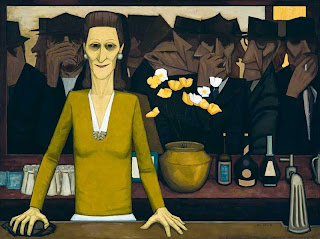
Recently I went to the wonderful John Brack exhibition at the NGV in Federation Square. I can highly recommend it (it's on until 9 August).

Writing in the Australian, Christopher Allen suggests that Brack's painting, including The Bar and Collins Street which are included here, suffered for a lack of empathy with their subjects. I never saw these famous and much loved paintings as lacking empathy; on the contrary, I thi nk The Bar empowers its female subject with a fabulous sense of superiority, and I think Collins Street implies a wonderful, somewhat distant other world that all of its subjects are thinking of, their real world, as they wait for their tram to transport them from the necessary daily drudgery of their work lives to the doubtlessly hollow evening home lives, but in their vacant faces I read a certain capitivation of thought and desire for their real, inner, private selves. Apparently, such a reading was not anticipated by Brack, who later regretted his patronising attitude to those subjects, seeing them as vacant and ignorant apparently, according to Allen. I guess it just goes to show that we all read something different out of art. I clearly am "wrong" in my reasing, not being an expert such as Allen. Then again, I do know what I like...

11 June 2009

South Park: A Hidden Gem of San Francisco


During my trip to San Francisco earlier this year I made sure to visit a rather delightful, if slighlty anachronistic, little residential square called South Park located in the extensive SoMa (South of Market) urban regeneration district.

This lovely little park has a chequered history. It was laid out by a developer in the 1850s and patently modelled on European residential squares to provide an upmarket, enclosed neighbourhood of townhouses facing onto a compact little urban park. In the 1890s it became a public park. The 1906 earthquake destroyed the neighbourhood and, while the park itself survived, the area went steadily downmarket and seedy (as indeed much of the SoMA area remains today, at least in my observation; it's a very schizophrenic environment, with huge glass and steel devleopments side by side with homeless missions - but I am digressing). South Park started sprucing up in the 1970s and '80s, as artists and other bohemian types attracted by low rents and its quirky charm, moved in, but they were sadly pushed out by the 1990s "dot com boomers" who took over the neighbourhood - a pity as it would have made a lovely artists' colony. Despite the new money apparently the park itseld remained a popular homeless and/or drug dealing haunt at nighttime. With the dot com bust in the early 2000s this square is now assuming its next personality. It seems an environment in transition - the housing stock surrounding it is nothing special, but there are several little cafes and the park itself is a charming little green oasis in an area of this lovely city that is not exactly blessed with a huge number of green spaces.

The size is just right - large enough for mature trees that provide a leafy outlook for the houses and offices overlooking the square, room to stroll and sit and chat, a small playground and open areas for children to run about or for people to laze about in the sun.

It's a public park so anyone can enjoy it, if they can find it. It is such a narrow little park squeezed into the middle of a standard sized city block and with very ordinary looking street opening, so "stumbling" across it is a little like stumbling across a long forgotten, somehow more genteel urban environment cloistered away from the rest of the modern city - how lovely and restful.
It's certainly not the busiest square in San Francisco, nor the grandest nor even the most beautiful. But it is a real little gem and it is the sort of balanced urban environment that I think comes close to perfection.