The Melbourne Museum is currently showing a fantastic exhibition called A Day in Pompeii. Like many people, I am fascinated by this lost city, its apparently pleasure-driven (at least for the elites) lifestyle, and its amazing preservation and archaeology. So I went along to see the exhibition today around 1pm and found the crowds were quite tolerable.
It's a huge exhibit with a large number of Pompeii artefact on display, and much detailed information about life in Pompeii, its architecture, social life, and of course its destruction, "rediscovery" and archaeology. It's very detailed, and includes a 3D animated film of the city's destruction which sounds ghoulish but is actually quite fascinating. There are the inevitable body casts, which are of course very emotional - even though these poor people died in 79 AD, their images at the moment of their deaths (mostly from asphyxiation, rather than burning) are so hauntingly preserved. I would have liked to have seen some more about the lives of the slaves, but overall it is a very comprehensive exhibition.
I learned some interesting things, such as the fact that graffiti was popular in Pompeii - people would write all sorts of saying, witticisms, poetry or political slogans on their houses. The only one I recall was this one: Sex, wine and baths ruin our bodies. But what is life without sex, wine and baths?
I also learned that most of the 20,000 citizens survived by fleeing after the initial eruption. I had always thought that they all died.
I highly recommend this exhibition and may even try to see it myself a second time before it closes in October.

Showing posts with label exhibitions. Show all posts
Showing posts with label exhibitions. Show all posts
15 July 2009
28 June 2009
Vanity Fair Portraits


The National Portrait Gallery in Canberra is showing an exhibition of celebrity portraits from Vanity Fair magazine spanning the 1920s and 30s and the 1980s to the present. These portraits of Douglas Fairbanks Jnr and his then wife Joan Crawford (top), Louise Brooks (middle) and Liza Minnelli (bottom) come from the exhibition. I saw the exhbition this week and it was quite a bit more interesting than the celebrity vanity piece I was expecting.
In reviewing this exhibition, Andrew Stephens of The Age suggests that Vanity Fair's appeal has lain in its promise to get "behind" the manufactured celebrity smiles to the "real" person underneath, which in this age of so-called "celebrity culture" where there is neither privacy nor mystery about any vaguely public figure is really no mean feat. I don't entirely agree that there is any real depth to these photos in terms of insight to the "real" celebrity: you are looking at highly posed, highly structured, highly controlled, generally contrived images of professionals whose job is to project an image taken by professionals whose job it is to capture glossy images of image professionals. In other words, there is no escaping the artifice of the subject or the situation. The photos do not give you any insights to who the "real person" may be beneath the air-brushed, posed image. And nor should they really - celebrities have a right to a public and a private persona, and why should we the masses have any right to see or even glimpse their private selves?
What the Vanity Fair "style" does seem to offer, however, more so than your standard celebrity mug shots, is a suggestion of intimacy and a highly polished presentation that makes the images at once engaging and interesting. All the famous images from the post-1983 incarnation of Vanity Fair are here: the iconic, celebrity-friendly images of Mario Testino, Herb Ritts, Annie Liebowitz, Bruce Weber and David Lachapelle. We have the dancing Nancy and Ronald Reagan, the smiling black and white grainy Princess Diana, Raquel Welch and the naked swimming team, Joan and Jackie Collins in sunglasses in the back of a limo, pregnant Demi Moore, all those "Hollywood" group tableaux.
Most interesting in my opinion were the photos from the earlier version of the magazine: the 1920s and '30s photos of not only movie stars but also writers (many of whom, like DH Lawrence, I had never even seen a photo of before), painters, dancers and other artists, suggesting the far broader palette of popular creative artists that existed in the earlier part of the last century compared to the movie star-obsessed focus of the early years of this century.


12 June 2009
John Brack exhibition

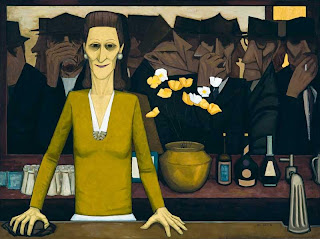

Recently I went to the wonderful John Brack exhibition at the NGV in Federation Square. I can highly recommend it (it's on until 9 August).
Writing in the Australian, Christopher Allen suggests that Brack's painting, including The Bar and Collins Street which are included here, suffered for a lack of empathy with their subjects. I never saw these famous and much loved paintings as lacking empathy; on the contrary, I thi nk The Bar empowers its female subject with a fabulous sense of superiority, and I think Collins Street implies a wonderful, somewhat distant other world that all of its subjects are thinking of, their real world, as they wait for their tram to transport them from the necessary daily drudgery of their work lives to the doubtlessly hollow evening home lives, but in their vacant faces I read a certain capitivation of thought and desire for their real, inner, private selves. Apparently, such a reading was not anticipated by Brack, who later regretted his patronising attitude to those subjects, seeing them as vacant and ignorant apparently, according to Allen. I guess it just goes to show that we all read something different out of art. I clearly am "wrong" in my reasing, not being an expert such as Allen. Then again, I do know what I like...
Subscribe to:
Posts (Atom)